
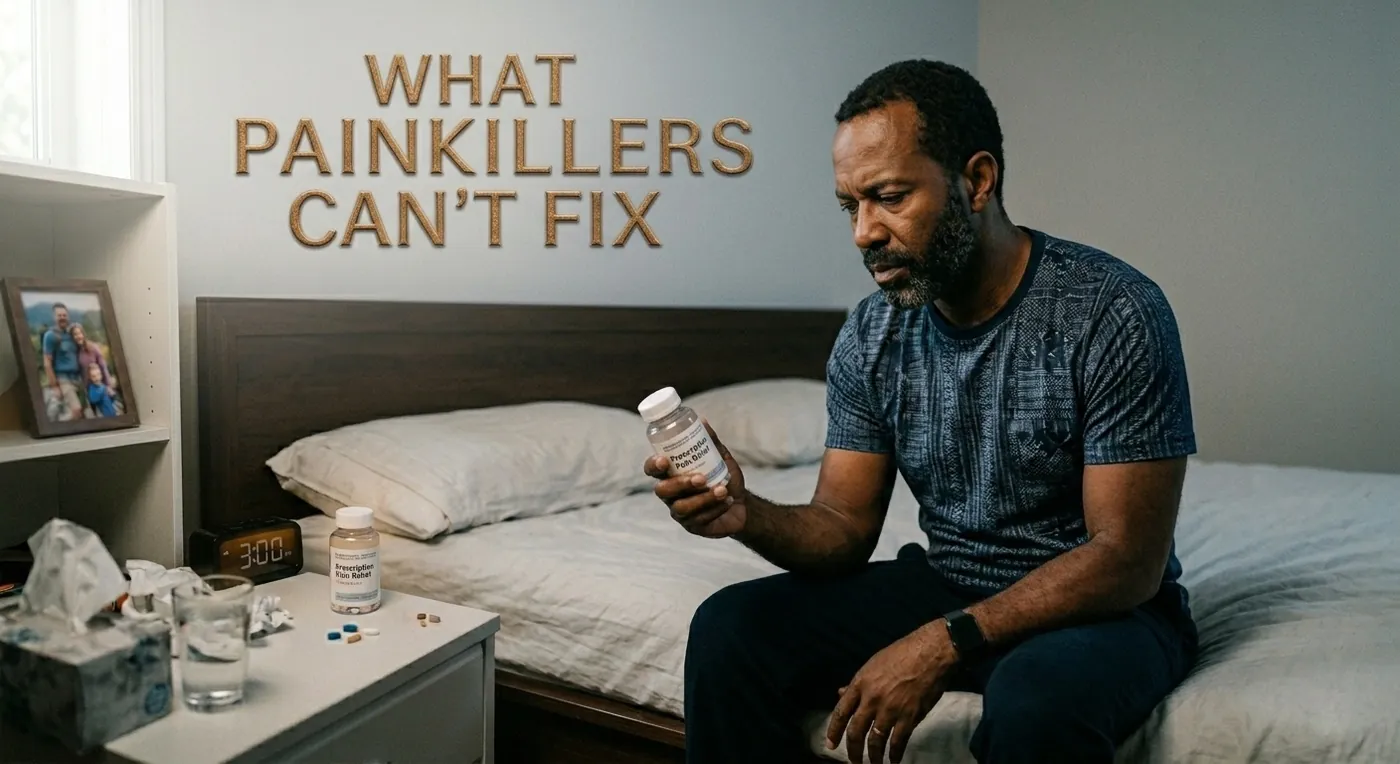

Peter kept ibuprofen on his bedside table for two years. Morning and night, 400mg. It worked at first. Then it worked a little less. Then he was taking it three times a day and his back still hurt by 7pm.

Nobody told him why. And that's the gap this article tries to close.

What the Drugs Actually Do

NSAIDs (ibuprofen, naproxen, Advil, Aleve)

When your back flares, tissue gets inflamed. That inflammation releases chemicals that irritate nearby nerves and make everything hurt. NSAIDs block the process that produces those chemicals. Less inflammation, less pain signal.

For a fresh back injury, this is genuinely useful. The evidence is solid for the first one to two weeks. The problem is they don't fix anything underneath. No muscle is rebuilt, no disc is healed, no movement pattern corrected. They turn the volume down while the problem stays on.

Topical gels and patches (Voltaren gel, lidocaine patches)

These do the same job but stay local. Diclofenac gel absorbs through the skin directly into the sore area. Lidocaine patches block pain signals at the nerve surface. Because far less enters your bloodstream, you get fewer side effects like stomach irritation or blood pressure changes. For pain in one specific area, these are often the smarter choice over oral tablets.

Muscle relaxants (cyclobenzaprine, Flexeril)

These work in the brain, not in the muscle itself. They reduce overall nervous system activity, which is why they make you sleepy. The research is not impressive. Studies show only a tiny reduction in pain compared to placebo, and adding them to ibuprofen doesn't seem to do much extra. Short term for severe spasm, maybe. Long term, not really.

Opioids (tramadol, oxycodone)

Here is where Peter's story takes a darker turn. Opioids work powerfully in the short term. But the body adapts. Receptors down-regulate. The same dose that helped in week two might need to be doubled by month six to feel the same effect. This is not weakness. It is just how the body responds to any repeated strong signal.

What makes it worse is something called opioid-induced hyperalgesia. With long enough use, opioids can actually increase pain sensitivity. The drug that was supposed to help has made the system more reactive, not less. The American College of Physicians recommends opioids only as a last resort, after everything else has genuinely been tried and failed.

The pill doesn't know what caused your pain. It only knows how to turn down the volume. For some people, that's enough. For most people with chronic pain, the root is still playing.

What Exercise Does Differently

Exercise is the only thing that changes the actual structure of the problem.

The deep muscles around your spine, the ones that hold your vertebrae stable during movement, get weaker and switch off in people with chronic back pain. Targeted exercise rebuilds them. No pill does that.

Your spinal discs have no direct blood supply. They get nutrients through movement, the physical pumping action of loading and unloading. A spine that isn't moving is a spine that is slowly starving its own discs.

Then there is the nervous system side of it. Chronic back pain often involves the brain turning up the pain signal beyond what the tissue actually warrants. Graded exercise, done gradually and consistently, is the best evidence-based way to retrain that response. The brain learns, over repeated exposures, that moving is safe. That recalibration is something no drug touches.

A 2025 network meta-analysis found exercise comparable or better than medication for chronic back pain, with better quality of life outcomes. The Cochrane review confirmed the benefits hold at long-term follow-up, which is what medication studies consistently fail to show.

So When Do Pills Make Sense?

They do make sense, especially early. In the first days of an acute flare, when pain is too high to move, medication creates a window. It reduces the signal enough that exercise becomes possible. That is a real and useful function.

The mistake is staying in that window indefinitely. The medication keeps opening the door. The structural work never walks through it.

The ACP guidelines put it plainly: for chronic back pain, exercise and non-pharmacological treatment come first. Medication is what you add if that isn't enough, not the other way around.

If the Pills Have Stopped Working

That's not a sign to try a stronger drug. It's almost always a sign that the pharmacological ceiling has been reached and the underlying problem still hasn't been addressed.

Peter eventually started a physiotherapy programme. Not because ibuprofen was dangerous, but because the gap between what the pill could do and what his back actually needed became too wide to ignore.

He needed his stabilising muscles rebuilt. He needed to stop moving like his spine was made of glass. He needed his nervous system to stop treating his own back as a threat.

Nothing on the pharmacy shelf does that. Some things on that shelf help you feel well enough to start. That's the point of them. Starting the work is what actually changes things.

And that's what Fesera is built for. The free assessment identifies your specific back pain type and gives you a programme that addresses the actual problem, not just the signal.